Nobody enjoys paying for a service where, if everything goes well, nothing appears to happen. That is the honest problem with a heating tune-up, and it is why a lot of homeowners skip it until the year the furnace does not light.
So rather than tell you a tune-up is important, here is the actual checklist. What gets looked at, why it is on the list, and what a technician is deciding when they look at it. Once you can see the work, you can tell the difference between a real service and forty minutes with a clipboard, which is the more useful skill.
The Checklist at a Glance
These are the five areas a thorough heating tune-up should cover.
| Area | What is checked | What it prevents | Commonly skipped? |
|---|---|---|---|
| Combustion | Burners, ignition, flame sensor, heat exchanger, flue | No-heat lockouts and safety failures | No |
| Airflow | Filter, blower wheel, motor amps, static pressure | Overheating, high bills, cracked exchanger | Static pressure often |
| Safety controls | Limit switch, pressure switch, rollout, CO check | Damage and genuine safety incidents | Rarely tested properly |
| Controls | Thermostat calibration, staging, wiring | Rooms that never reach setpoint | Sometimes |
| Electrical | Disconnect, capacitor, contactor, connections, amp draw | Hard starts and no-heat calls | Ask whether it is tested |
That last row is worth asking about directly, and we will come back to it.
The Combustion Side
This is what people picture when they think of a furnace service, and it is genuinely the safety-critical part.
The burners get inspected and cleaned. Dirty burners fire unevenly, which wastes fuel and produces a flame pattern that scorches the exchanger over time. The ignition system and flame sensor get tested and cleaned, and the flame sensor in particular is worth naming: a sensor with a light coating of oxidation is the single most common reason a modern furnace lights, runs for a few seconds, and shuts off. It is a five minute clean during a tune-up and an emergency call in January.
Then the heat exchanger. This is the wall between the combustion gases and the air you breathe, and a crack in it is both invisible from the outside and genuinely dangerous. It gets inspected properly, not glanced at. The flue and venting get checked for blockage, corrosion and proper draft, which matters especially in older homes where a modern furnace may be venting into a chimney built for something else.
The Airflow Side
Airflow is where most of the preventable damage happens, and where the difference between a thorough technician and a quick one shows up most clearly.
Checking the filter is the minimum. A thorough tune-up should also include pulling the blower wheel to look at it, because a blower wheel with a build-up of dust on the fins moves dramatically less air than a clean one while drawing more current. It should include measuring static pressure across the system too, which is the closest thing there is to a blood pressure reading for ductwork.
- Filter condition and the right size. A filter that is too restrictive for the system causes the same problems as one that is filthy.
- Blower wheel cleanliness and motor amp draw against the nameplate rating.
- Static pressure, which tells you whether the duct system can actually move the air the equipment is trying to push.
- Return air adequacy, since a furnace starved of return air overheats and trips its limit switch, which the homeowner experiences as a furnace that keeps shutting off.
- Temperature rise across the exchanger, measured and compared with the manufacturer's specified range.
Our ductwork fabrication is in-house, so if a static pressure reading points to a duct problem, the fix stays with us rather than going to another contractor.
Safety Controls, Tested Rather Than Observed
Every furnace has a set of controls whose entire job is to shut the system down before something bad happens. The limit switch, the pressure switch, the rollout switch.
The distinction that matters is between checking that a system runs and testing that it stops. A furnace can run perfectly all winter with a failed limit switch, because the limit switch only does anything on the day something else goes wrong. That is exactly the day you need it to work.
A thorough tune-up should test these, and should include a carbon monoxide check around the appliance. It is a short part of the visit and it is the part with the highest stakes.
The Electrical Side of a Heating System
This is where the license matters, and it is not a marketing point. It is a practical one.
Callison holds a VA Class A dual license covering both HVAC and electrical, number 2705111964. Almost no local competitor holds both. What holding both means practically is that the electrical side of your heating system, the circuit, the disconnect and the panel that feed it, sits inside our license along with the equipment itself, so a fault that crosses that line does not have to be handed to a second contractor.
These are the electrical items a thorough tune-up should test rather than glance at.
- Capacitors, which weaken gradually and measurably before they fail outright. A capacitor tested at well below its rated value is a scheduled part, not an emergency.
- Contactors, where pitted or burned contacts cause intermittent starting faults that are maddening to diagnose in the middle of a cold snap.
- Wiring connections, which loosen with thermal cycling. A loose connection heats up, and heat accelerates the loosening.
- The disconnect and circuit, checked for correct sizing and condition.
- Amp draw under load, compared with the nameplate. A motor pulling high amps is telling you something months before it stops.
- Panel capacity if you run electric backup heat, since heat strips are a substantial load and a marginal panel shows up in January rather than July.
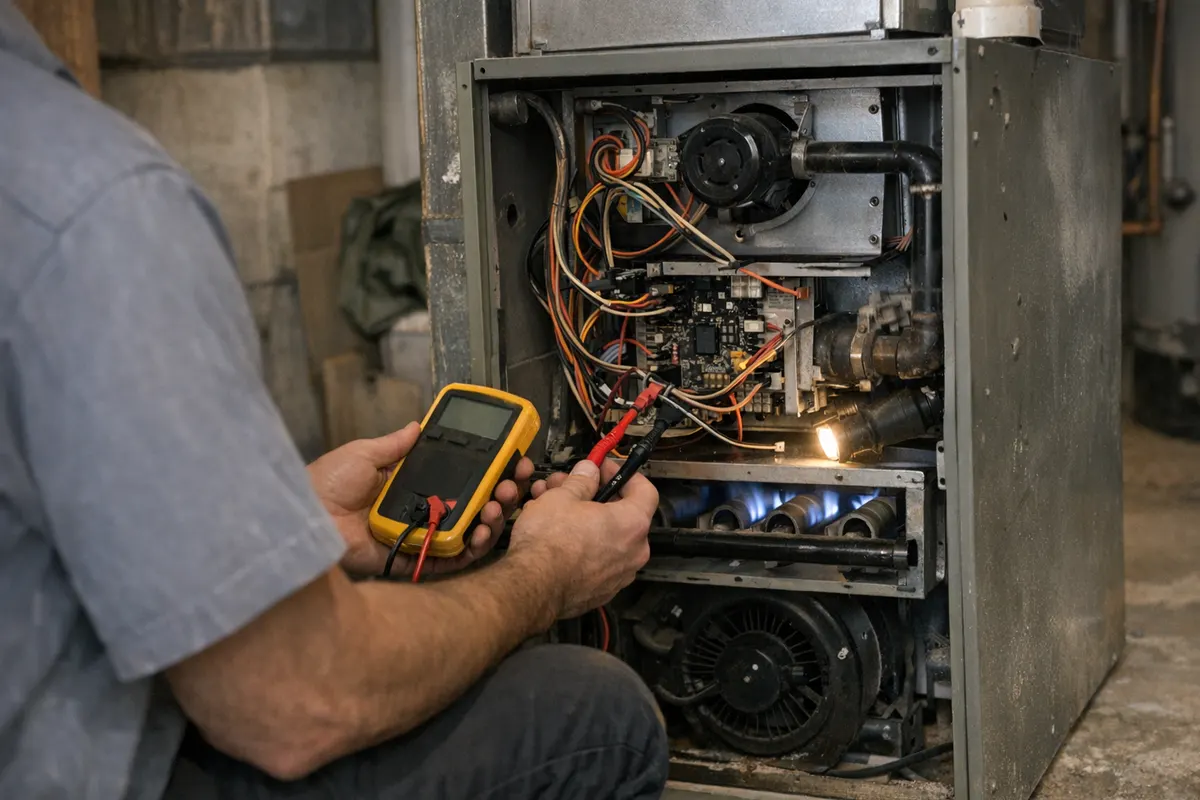
None of this is exotic work, but it does need a meter rather than a flashlight. If you are comparing tune-up quotes, ask each company directly whether the electrical components are tested or just looked at.
What Older Staunton Homes Turn Up
In an older home, the heating system is often much newer than the house around it, and that mismatch produces its own recurring set of findings. Equipment gets replaced as it wears out. The chimney, the ductwork and the building envelope around it do not.
- Modern furnaces venting into old masonry chimneys. Liner deterioration is a genuine safety item and it is not visible from inside the house.
- Ductwork in unconditioned crawl spaces, losing heat that then gets blamed on the equipment.
- Return air that was never sized for the current furnace, which shows up as a system that overheats and shuts itself off.
- Thermostat wiring inherited from a previous system, where a mismatch produces odd behavior rather than an outright fault.
- Homes tightened up since the furnace went in, sometimes no longer supplying enough combustion air for it to burn cleanly.
What a Tune-Up Will Not Do
Being straight about the limits is the fastest way to show a tune-up is not a sales exercise.
It will not fix ductwork that never reached the far bedroom properly. It will not add capacity to a system that was undersized when it was installed. It will not make a twenty-two year old furnace into a reliable one, and if a tune-up finds a cracked heat exchanger the honest answer is that the system needs replacing rather than servicing.
What it reliably does is catch the cheap failures before they become expensive ones, confirm the system is safe to run, and give you a realistic read on how many seasons are left. That last one is worth more than people expect, because it converts a future emergency into a purchase you can plan and budget for rather than one made in a panic on the coldest night of the year.
Why Homeowners Call Callison
We are family owned in Staunton and have been since 2003. The dual license is the thing that genuinely separates us here: when a heating diagnosis turns out to be a capacitor, a contactor, a circuit that cannot carry the load, or a panel that needs attention, one company handles all of it rather than coordinating between two.
- Family owned in Staunton since 2003
- VA Class A dual license, HVAC and electrical, #2705111964
- BBB A+ rating
- In-house ductwork fabrication
- RUUD installer
- Same-day service when called before noon
- Weekend emergencies
- 1-year workmanship warranty
- Upfront pricing
- Financing available
We serve Staunton, Waynesboro, Fishersville, Stuarts Draft, Verona, and all of Augusta County. Full details are on our heating and cooling page, or see where we work on our service areas page.