

Leaky Ductwork: Why Your House Will Not Cool
The vents blow cold, the unit is clearly running, and the house still sits three degrees warm. Here is where your cooling is going.
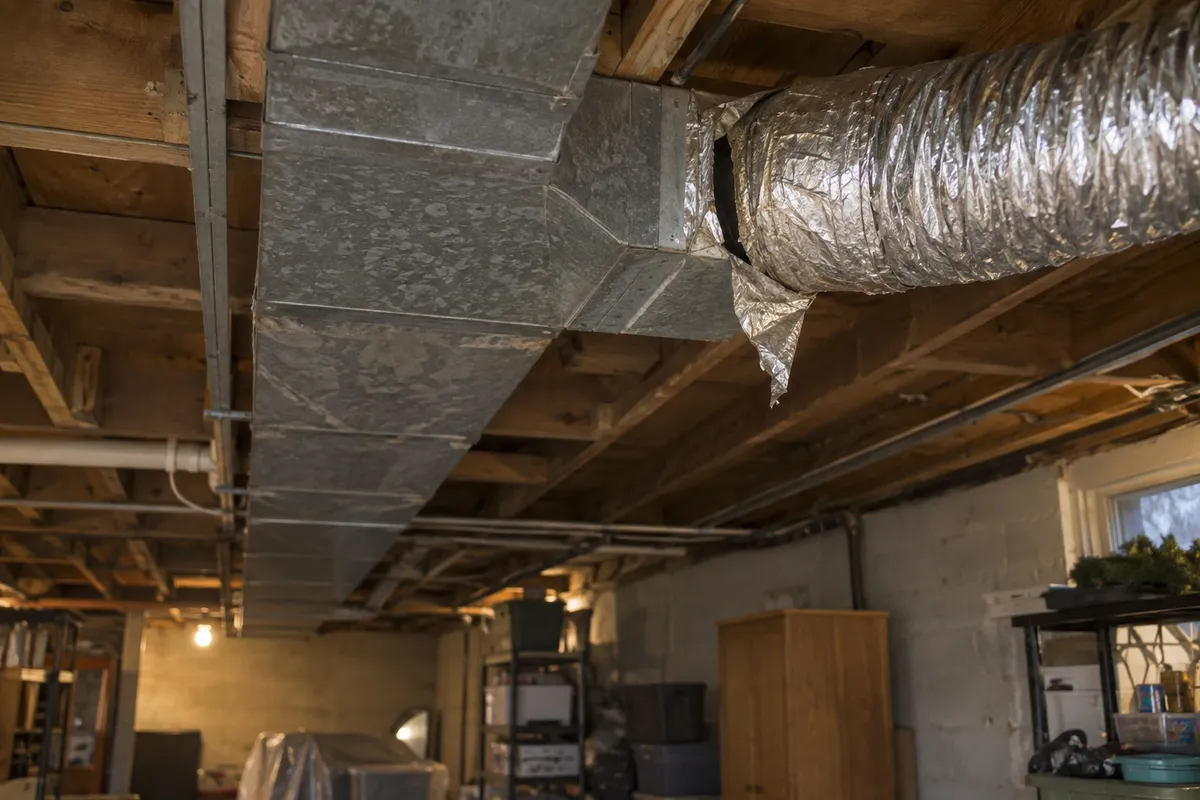
When your equipment is producing cold air but the house never cools, the problem is usually between the two. The U.S. Department of Energy estimates a typical home loses 20 to 30 percent of the air moving through its ducts to leaks and bad connections. When ducts run through unconditioned crawlspaces and attics, that air is gone entirely. Have the ducts checked before anyone sells you a bigger system. Call 540-294-3189.
It is one of the most frustrating problems a homeowner in Staunton, Waynesboro, or Fishersville can have, precisely because everything looks like it is working. Put your hand at a vent and the air is cold. Walk outside and the condenser is running. The thermostat is set where it always is. And the house is still uncomfortable at four in the afternoon while the power bill climbs.
When the equipment is doing its job and the house is not getting the benefit, the ductwork is the first place to look. Below is how to recognize the signs, where leaks actually occur, what they cost you in three separate ways, and what a real repair involves.
Duct Problems at a Glance
| What you notice | Likely cause | Where to look |
|---|---|---|
| Some rooms never cool, others fine | Leak or crushed run serving those rooms | Crawlspace or attic above the affected rooms |
| Weak airflow everywhere | Major leak, disconnection, or undersized trunk | Near the air handler |
| Dust returns right after cleaning | Return-side leak pulling in unconditioned air | Return ducts and the filter housing |
| House feels humid despite running | Return leakage pulling in humid crawlspace air | Return runs in the crawlspace |
| Crawlspace or attic feels cool | Supply leak conditioning the wrong space | Anywhere along the supply runs |
| Bills rising, habits unchanged | Cumulative leakage | Whole system; needs measurement |
Why Ducts in Crawlspaces and Attics Cost More
In homes across Staunton, Verona, Stuarts Draft, and the surrounding Shenandoah Valley, ductwork that runs through crawlspaces and attics rather than inside the conditioned envelope is what turns a small leak into a real expense.
A leak in a duct running through a finished basement leaks conditioned air into a space you are already conditioning. Annoying, but the energy is not entirely wasted. A leak in a crawlspace dumps that air under your house. A leak in an attic dumps it into a space that can exceed 130 degrees in August. That air is simply gone, and you paid to cool it.
The second factor is age. Duct systems installed decades ago were often sealed with cloth duct tape, which despite the name is one of the worst materials available for the job. The adhesive dries out and releases, frequently within a few years. If your ducts were sealed with it, those joints have almost certainly opened by now.
The Signs Your Ducts Are Leaking
Duct problems announce themselves differently from equipment problems. Equipment failures tend to be abrupt. Duct problems creep, which is why households often adapt without ever naming the issue.
- Uneven rooms. Some rooms never get comfortable while others are fine. Uneven temperature is a distribution problem, not a capacity problem, and buying more capacity will not fix it.
- Weak airflow at the registers even though the blower is clearly working hard.
- The system runs constantly and rarely satisfies the thermostat, particularly in the afternoon.
- Power bills climbing year over year with no change in habits, occupancy, or rates.
- Dust that returns immediately after cleaning. Leaky return ducts pull in crawlspace and attic air along with everything suspended in it.
- A musty smell when the system first kicks on, which usually means the return is drawing from somewhere it should not.
- The crawlspace or attic feels conditioned. If the unfinished space is noticeably cool on a hot day, you are paying to cool it.
- Visible damage. Disconnected sections, torn flex duct, insulation hanging loose, or old tape peeling away from joints.
If several of those describe your house, ducts are worth investigating before anyone starts quoting equipment.
Where Ducts Actually Leak
Leaks are rarely one dramatic hole. They are usually a dozen small ones adding up to a significant total, which is part of why they go unnoticed for so long.
- Joints and seams. Every connection between duct sections is a potential leak, and a typical system has a great many of them.
- Boot connections. Where the duct meets the register at the floor or ceiling. Extremely common, and easy to miss because the register plate hides it.
- Failed duct tape. As above. Mastic or foil tape rated for the application is what should be there.
- Crushed or kinked flex duct. Flexible duct is easy to install and easy to install badly. A sharp bend, or a section crushed by boxes stored in a crawlspace, strangles everything downstream.
- Disconnected runs. More common than you would think, often after someone else has been working in the crawlspace for an unrelated reason.
- Rodent and pest damage, which can tear or flatten flexible duct in crawlspaces and attics.
- Missing or fallen insulation. Not a leak, strictly, but a bare metal duct crossing a hot attic loses cooling just as effectively as a hole does.
Supply Leaks vs Return Leaks
These cause different problems, and knowing which you have changes what the fix looks like.
Supply leaks occur on the side pushing conditioned air out to your rooms. Cool air escapes before it arrives. The symptoms are weak airflow, rooms that will not cool, and a system running far longer than it should. It is straightforwardly wasted money, and it is the easier of the two to reason about.
Return leaks occur on the side pulling air back to the equipment, and they are worse in ways that are less obvious. Instead of drawing air from your living space, the system draws it from wherever the leak is. In a crawlspace that means humidity, dust, and mold spores. In an attic it means air that may be well over 120 degrees, which your air conditioner then has to cool from scratch, on top of everything else it is doing.
There is a further consequence. A house with significant return leakage runs slightly negative in pressure, which pulls unconditioned outside air in through every gap in the building envelope. That is why some homes feel humid no matter how long the system runs, and why simply adding capacity does not solve it.
What This Costs You, Three Ways
The energy. If a quarter of your conditioned air never reaches a room, the system runs meaningfully longer to reach the same temperature. That shows up on every summer and every winter bill, because ducts leak in both seasons.
The equipment. A system that runs constantly wears out sooner. Compressors and blower motors have a finite number of hours in them, and duct leaks quietly consume those hours. The replacement then arrives years earlier than it should have, which is a far larger expense than the duct repair would have been.
The wrong purchase. This is the expensive one and the reason we push on it. A homeowner with leaky ducts reasonably concludes their system is undersized. They buy a bigger one. The new system feeds the same leaking ducts, the house still will not cool evenly, and now they have spent several thousand dollars and still have the original problem. Checking the ducts first is far cheaper than buying equipment you may not need.
There is a related failure mode worth knowing about. Restricted airflow from crushed or blocked ducts is one of the causes of an air conditioner that keeps freezing up. If you have had both symptoms, they are very likely the same underlying problem rather than two.
How Duct Problems Actually Get Fixed
A proper repair follows a sequence, and the measuring step is the one that separates a real diagnosis from a guess.
- Inspection. A technician physically goes into the crawlspace or attic and traces the runs, looking for disconnections, crushed sections, failed tape, pest damage, and missing insulation.
- Airflow measurement. Measuring what is actually being delivered at each register and comparing it against what the system should produce. Numbers, not impressions.
- Sealing. Mastic on joints and seams, or foil tape rated for duct use. Never cloth duct tape, which will simply fail again.
- Replacing what cannot be sealed. Crushed flex, badly deteriorated sections, and undersized runs get replaced rather than patched.
- Insulating. Any duct passing through unconditioned space needs proper insulation, otherwise you have moved the loss from leakage to conduction and gained little.
- Balancing. Adjusting dampers so each room gets its share, rather than the rooms nearest the air handler taking most of the airflow.
Sometimes the honest answer is that the duct design itself is wrong rather than merely leaky: undersized trunk lines, too few returns, or a system extended into an addition without anyone recalculating the load. In those cases sealing helps but will not fully solve it, and the lasting fix is resized or rerouted runs.
This is where fabricating ductwork in our own Staunton shop matters. When a run needs to be a different size, or a fitting needs a shape nobody stocks, we build it correctly instead of forcing an off-the-shelf part to do a job it was not made for.
What You Can Check Yourself
Before calling anyone, a few things are worth a look if you can safely access the space.
- Walk the crawlspace or attic with a flashlight and look for anything obviously disconnected or hanging loose
- Feel along accessible joints with the system running; escaping air is easy to detect by hand
- Check whether ducts in unconditioned space are insulated and whether that insulation is intact
- Look for old cloth duct tape, which is a reliable indicator of joints that have already failed
- Compare airflow at a register close to the equipment against one at the far end of the house
- Make sure nothing is stacked on or crushing flex duct in the crawlspace
Two safety notes. Do not enter a crawlspace or attic you are not comfortable in, and do not attempt sealing work in an attic during a Virginia August. Attic temperatures in July and August here are genuinely dangerous, and this is not a job worth a heat illness.
Before you buy a bigger system. If a contractor has recommended replacing your equipment because the house will not cool evenly, get the ducts measured first. A larger system feeding leaking ducts usually does not fix uneven cooling, and duct repair is a fraction of the cost. See our heating and cooling page, or ask about financing if the timing is difficult.
Why Augusta County Homeowners Call Callison
Callison Electric Heating & Cooling has been a family-owned business in Staunton since 2003. We fabricate custom sheet-metal ductwork in-house, so every run is made to fit your home.
We hold a Virginia Class A dual license covering both HVAC and electrical, and almost no local competitor holds both. On a duct job that may not matter, but when the work grows into a new air handler or a circuit that cannot carry the load, one company handles all of it.
- Family owned in Staunton since 2003
- VA Class A dual license, HVAC and electrical, #2705111964
- Ductwork fabricated in our own shop, not ordered in and made to fit
- BBB A+
- Duct repair, sealing and airflow balancing
- Air duct and dryer vent cleaning
- 1-year workmanship warranty
- Upfront pricing, quoted before work begins
- Same-day service available when you call before noon, plus weekend emergency calls
We serve Staunton, Waynesboro, Fishersville, Stuarts Draft, Verona, and all of Augusta County. See where we work on our service areas page.
Find out where your cooling is going
Duct repair, sealing and airflow balancing, with ductwork fabricated in our own shop. Upfront pricing, quoted before we start.
Related guides
Common questions
Real questions from Staunton and Augusta County, with straight answers.
Call 540-294-3189