

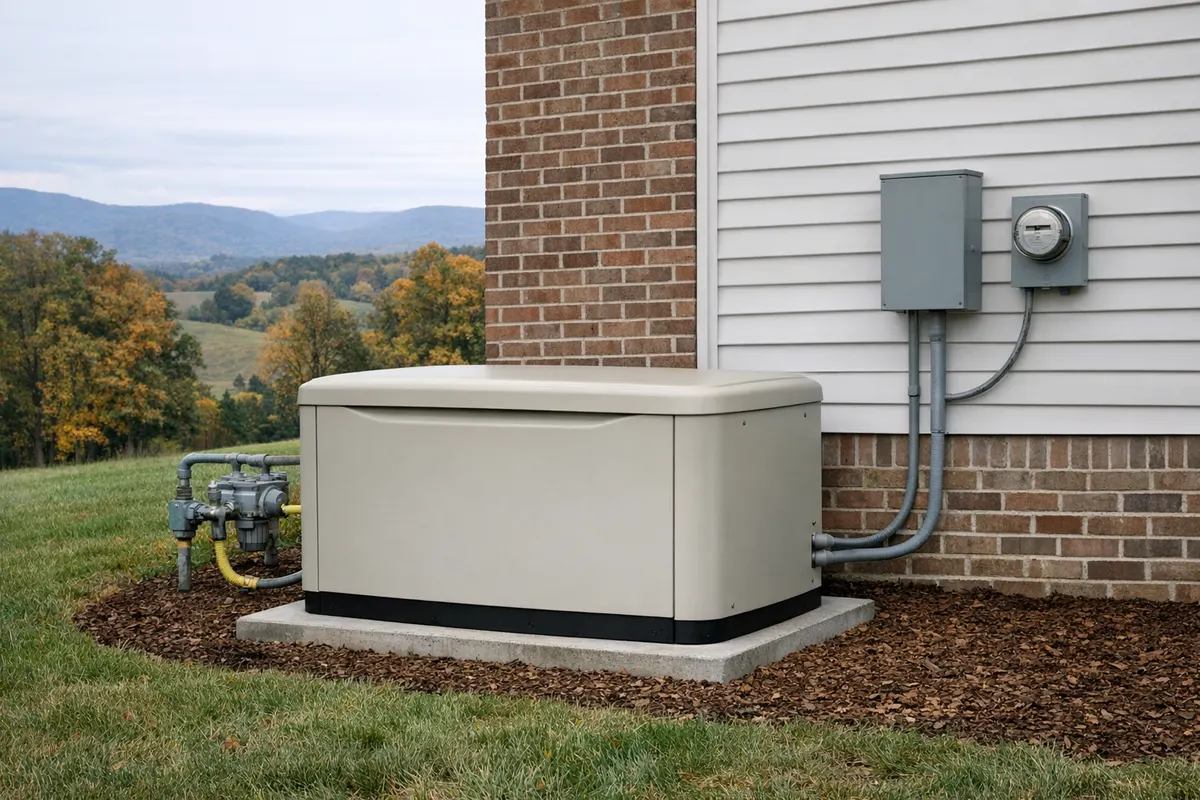
A standby generator usually comes to mind on the second or third day of an outage, and the research tends to start about a week later once the freezer has been dealt with. By then the urgency has faded and the process looks opaque, which is where a lot of projects stall.
So here is the whole thing laid out. What happens at each stage, what actually determines how long it takes, and where the two expensive mistakes get made. A standby generator is not a complicated purchase once you can see the sequence, but it is genuinely two trades in one job, and that shapes everything about how it should be run.
The Six Stages
Every whole-home generator install goes through these, in this order.
| Stage | What happens | Who does it | Gets skipped? |
|---|---|---|---|
| 1. Load assessment | Measure what the house actually draws | Electrical | Often, and it is the big one |
| 2. Siting | Clearances, noise, exhaust, gas and panel runs | Both trades | Sometimes rushed |
| 3. Permits | Electrical and gas permits with the locality | Contractor | Should never be |
| 4. Fuel connection | Gas line sized, run and pressure tested | Gas side | Undersized surprisingly often |
| 5. Electrical and transfer switch | Transfer switch, circuits, bonding, grounding | Electrical | Spec decided too late |
| 6. Commissioning | Load test under real conditions, handover | Both trades | Frequently token |
Stages one and five are where the money is won or lost. Stages three and four are where the timeline is decided.
Stage One: What Your House Actually Draws
This is the stage most worth insisting on, because getting it wrong is expensive in both directions and it is the stage most easily replaced with a guess.
An undersized generator is the obvious failure. It runs at its limit, struggles when the well pump and the heat come on together, and either trips or shortens its own life. A generator that cannot actually carry the house during an outage has failed at the one job you bought it for.
Oversizing is the quieter mistake. A generator considerably larger than the load costs more to buy, more to install, more to fuel, and often runs less efficiently at light load. Nobody complains about it because it works, which is precisely why it happens.
The honest version is a load calculation rather than a rule of thumb based on square footage. That means looking at what is actually in the house and what has to run simultaneously.
- The heating system. A gas furnace draws modestly. Electric backup heat strips are an enormous load and change the answer completely.
- The well pump, if you are on a well. Starting current matters more than running current here.
- Air conditioning or a heat pump, and whether you want it running during an outage or are content to go without.
- Water heater, and whether it is gas or electric, which is a large swing.
- The kitchen, particularly an electric range and the refrigeration you actually care about.
- Medical equipment or a home office, which are often the real reason for the purchase and should be sized for deliberately.
Our guide to what size generator you need goes through the arithmetic in more detail. The short version: if a quote arrives without anyone having asked what heats your water, it was not a calculation.
Stage Two: Siting
Where the unit goes is more constrained than most people expect, and getting it right early avoids expensive re-routing later.
Manufacturers specify minimum clearances from the house, from openings such as windows and doors, and from combustible material. Exhaust has to discharge away from anywhere it could reach a window, a vent or a neighbor. There are also practical considerations that do not appear in any manual: the unit exercises itself weekly, so siting it under a bedroom window is a decision you will regret on a Tuesday morning.
Two runs also get decided here, and both cost money by the foot. The gas line from the meter or tank, and the electrical run to the transfer switch. A location that looks tidy but sits eighty feet from both adds real cost to the job. Somewhere sensible near the meter and the panel usually costs less and works better.
Stage Three: Permits
Permits are commonly required for a whole-home generator, often both an electrical permit and a gas permit. Check with your locality, because the specifics vary from one to the next.
This is worth being direct about: permitting is not optional, and a contractor offering to skip it is not saving you money. It creates a problem at resale, it can affect an insurance claim if anything ever goes wrong, and it means nobody independent has checked the work on a system that combines fuel gas and electrical service.
Permitting and inspection scheduling is also the single most common reason a generator project takes longer than the homeowner expected. The physical work is a matter of days. The paperwork and the inspection calendar are what set the actual timeline, along with equipment lead time.
Stage Four: The Fuel Connection
Generators run on natural gas or propane, and the choice is usually made for you by what the property already has.
What matters more than the fuel type is whether the supply can actually deliver. A gas line sized for a furnace and a water heater is not automatically sized for a furnace, a water heater and a generator running at full output. If the line is undersized, the generator will start fine and then struggle under load, which is a maddening fault to chase after the fact because everything looks correct.
Whoever handles the fuel connection should size the line for the total connected load and pressure test it. On propane, tank capacity and regulator sizing come into it too, along with the practical question of how long you can actually run before a refill, which is worth knowing before an outage rather than during one.
The fuel connection is a separate part of the job from the electrical work, and it carries its own permit and inspection. Before you sign anything, ask any installer plainly how the fuel connection will be handled, who will do it, and how it will be permitted. A clear answer up front is worth more than a low number on a quote that leaves it vague.
Stage Five: The Transfer Switch
This is the component that decides how the system actually behaves, and the decision that homeowners are least often walked through properly.
The transfer switch is what disconnects your house from the utility and connects it to the generator. That isolation is not a convenience feature. It is what stops your generator backfeeding onto the utility lines, which is a serious hazard to line workers and the reason this work is licensed.
The choice is between covering the whole panel and covering selected circuits, and it should be a deliberate conversation rather than whatever the installer defaults to.
- Whole-panel transfer means everything works normally during an outage. It requires a generator sized for the whole house, so it costs more up front.
- Essential-circuits transfer covers a defined subset: heat, well pump, refrigeration, some lighting and outlets. Considerably cheaper, and it works well as long as the list is chosen thoughtfully.
- Load management is the middle path, where the system sheds a large load such as air conditioning when something bigger starts, allowing a smaller generator to cover more of the house.
- Automatic versus manual. Automatic switches over on their own within seconds, which matters if the house is ever empty during an outage.
This stage frequently also surfaces the panel itself. Older panels sometimes have no room for what the install needs, or are already at capacity, and that is better found during design than on installation day. Our guide to panel upgrades covers when that becomes necessary.
Stage Six: Commissioning
The last stage is the one most often reduced to starting the unit and shaking hands, and it is worth more than that.
A proper commissioning runs the generator under real load, not just at idle. That means simulating an outage, letting the transfer switch operate, and confirming the system carries what it was sized to carry with the heat and the well pump actually running. Starting a generator with nothing connected proves very little.
Handover should cover how to run the weekly exercise cycle, what the indicator lights mean, what the maintenance schedule is including oil and filter intervals, and what to do if it does not start when you need it. You should also leave with the permit and inspection documentation.
The Electrical Side, and the Question to Ask About Fuel
A generator install sits on the line between two kinds of work. The fuel connection is one. The transfer switch, the panel and the circuits are the other. How an installer splits that work shapes the schedule, the permits, and who answers for the result if something does not work.
So ask the question early. Where the work is split, the split is where scheduling slips, where responsibility gets ambiguous, and where the load calculation and the transfer switch spec can end up decided by whoever happened to quote first. Knowing who handles the fuel connection, and how it is permitted, before work starts avoids all three.
Callison holds a VA Class A dual license covering both HVAC and electrical, number 2705111964. Almost no local competitor holds both. On a generator job, the electrical license covers the transfer switch, the panel and the circuits, which is the stage where the system's behavior is decided. Holding the HVAC license as well means the heating equipment the generator has to carry, whether a gas furnace or a heat pump with backup heat strips, is part of our own trade rather than a guess on a load sheet.
- Family owned in Staunton since 2003
- VA Class A dual license, HVAC and electrical, #2705111964
- BBB A+ rating
- 1-year workmanship warranty
- Upfront pricing
- Financing available
We serve Staunton, Waynesboro, Fishersville, Stuarts Draft, Verona, and all of Augusta County. More on the electrical side is on our electrical services page, or see where we work on our service areas page.